I got the BOSS back when it 1st came out and I think it is a extremely well engineered machine. Plus unlike most other Delta machines it is QUIET; I love Quiet, all of the typical Delta machines like my 1" belt sander make as much noise as a garbage truck, I hate it, and won't consider Delta unless I hear it run 1st.
As I moved away from woodworking and into shoe making I used the BOSS very little but found that I needed a spindle sander for critical finish work on the leather soles and heels.
The problem is the oscillation; the spindle must be stationary. So I decided to figure out how to disable the oscillation motion.
After successfully removing the two links and locking the the motor in the up-most position I realized that I had a great opportunity to make an adjustable height system.
I am so far very happy with the results.
I love ALL Crafts and have a fantastic shop where I mostly make tools for shoe Making and Shoes Trained as a Draftsman over 40 years ago I spent most of that time in Advanced Vehicle Engineering. With a BFA in Crafts from CCS I have been making art in my studio all that time too. I currently teach Leather working & Shoe Making at CCS in Detroit
Wednesday, June 12, 2013
Monday, June 10, 2013
Shop charts - Drill size reverse look up chart
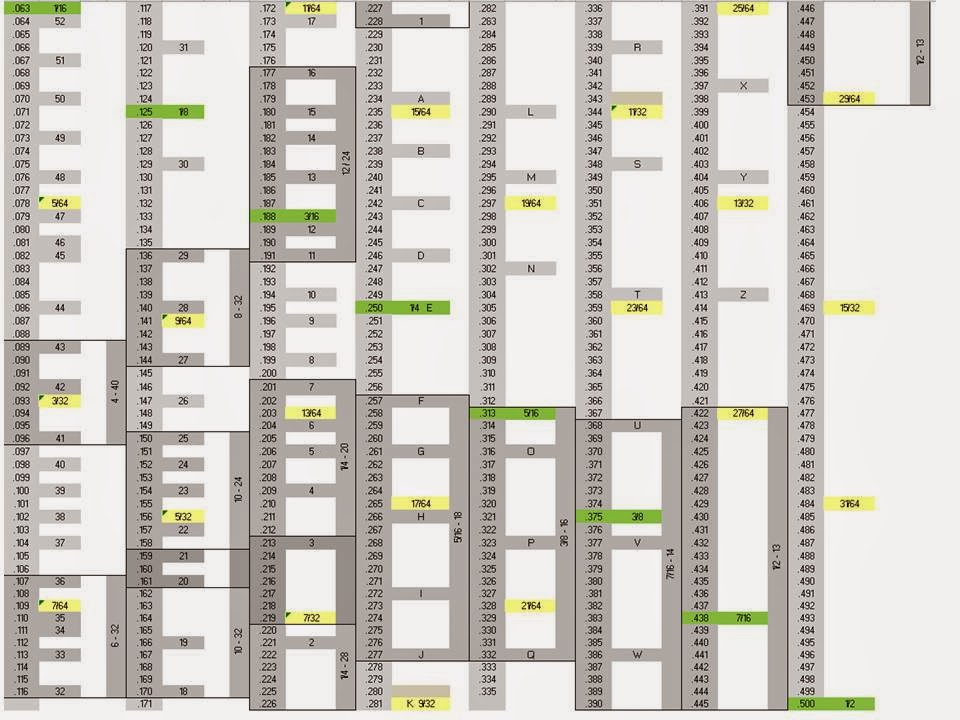
I just like this way better; instead of the standard drill size charts I spent all the time to make this far better method for finding drill sizes.
I have always disliked going through the process of "finding the closest" when using standard drill charts, this mostly occurs when I am doing restoration work.
There are two ways you look up drill sizes:
This chart allows you to find the exact number that you have on the micrometer in your hand and decide how to proceed with the standard sizes available.
The reason I like this method is because when you are standing there with the micrometer in your hand and you have decided on the number that you like, that number is not on the standard charts, only something close to it. With this chart you focus on the exact number on the micrometer, then start looking for standard sizes. It's an easier "reverse look-up" than doing the math in your head.
I added the common fastener sizes and again I think it is easier to see the whole range at a glance than any other way.
When you look at it the gaping holes jump out, it seems like almost any other system of standard sizing would have been better but this is what we have to work with.
Hope you find this useful.
07.30.13
After using my chart on several projects I am completly sold on it; it is so much better to have each number than it is to start with doing the math in your head every time you want to assess a dimension.
I have always disliked going through the process of "finding the closest" when using standard drill charts, this mostly occurs when I am doing restoration work.
There are two ways you look up drill sizes:
- Start with existing sizes and get the decimal equivalent.
- Measure something and find what is closest.
This chart allows you to find the exact number that you have on the micrometer in your hand and decide how to proceed with the standard sizes available.
The reason I like this method is because when you are standing there with the micrometer in your hand and you have decided on the number that you like, that number is not on the standard charts, only something close to it. With this chart you focus on the exact number on the micrometer, then start looking for standard sizes. It's an easier "reverse look-up" than doing the math in your head.
I added the common fastener sizes and again I think it is easier to see the whole range at a glance than any other way.
When you look at it the gaping holes jump out, it seems like almost any other system of standard sizing would have been better but this is what we have to work with.
Hope you find this useful.
07.30.13
After using my chart on several projects I am completly sold on it; it is so much better to have each number than it is to start with doing the math in your head every time you want to assess a dimension.
01.30.14
Added some overlap tap groupings.
Sunday, June 2, 2013
2 Sided tape Splitter for leather work
For leather work two sided tape can be a huge time saver. This model from 3M (#S-17454) is the best however... the minimum width is a 1/2". The tape film itself is only 0.002" thick; very nice.
So I made this 1/4" splitter. The Exacto blade is 0.020" thick so it is mounted .240" above the table. It must have the screw near the end to keep the blade from rising as you cut.
I used a 1/2" x 1.3" x 3.2" piece of black nylon to make this splitter. I made this little gem for my new friend Lisa Sorrell.
So I made this 1/4" splitter. The Exacto blade is 0.020" thick so it is mounted .240" above the table. It must have the screw near the end to keep the blade from rising as you cut.
I used a 1/2" x 1.3" x 3.2" piece of black nylon to make this splitter. I made this little gem for my new friend Lisa Sorrell.
Tuesday, April 23, 2013
Vintage Drill Bit Holders
I became fixated on this particular style of vintage drill bit holder and spent several months searching on EBay to finally acquire these two beauties.
I will need to do a restoration paint job on the fractional holder in the future.
Quite a mess so after water blasting I decided to etch the surface so that my paint job would not end up like the original. It seems like a zinc casting so it is nice and heavy but the original surface was so smooth that blue paint had nothing to bite into. I went with a tough gloss black enamel and the next day scraped off each of the fractions, very readable.
Without drills in it the holes appeared to be all parallel but to my surprise they are fanned out to make it easier to handle the drills. The designer went for 4 rows of 8 drills that left 3 extra... so there are four 1/16 bits; brilliant!
I have been designing my own Letter drill set holder but have not settled on a design yet. When I do I will mill it out of heavy tooling foam or aluminum. submit your ideas!
25
07.22.13
I picked up one of these diamond shaped Cleveland Drill holders for another numbered drill set and was so impressed with the usefulness of the design that I quickly went for the fractional size too.
A very nice design; the 64ths run up one side and all the other sizes on the right side, its easy to read and heavy enough to stay on the table. The numbered set goes from 1 to 60 with the odd numbers on the left and even numbers on the right.
Next came this totally unique folding case, normally I dislike folding cases because they are hard to use, hard to read, and hard to keep open. Now this General case solves all of the above issues and does it with beautiful design.
Although not small it is for good reason, it is wide and thin compared to the standard three row case.
When open we have only two rows with this clever folding size plate that has both the fractions and the decimals listed together, big enough and contrasting enough to read easily. In addition it has a Tap drill size chart on the inside of the cover.
It stays open via this cool little red kickstand on the right. All in all a great little design albeit big and heavy its a nice example of let's do it right!
09.21.13
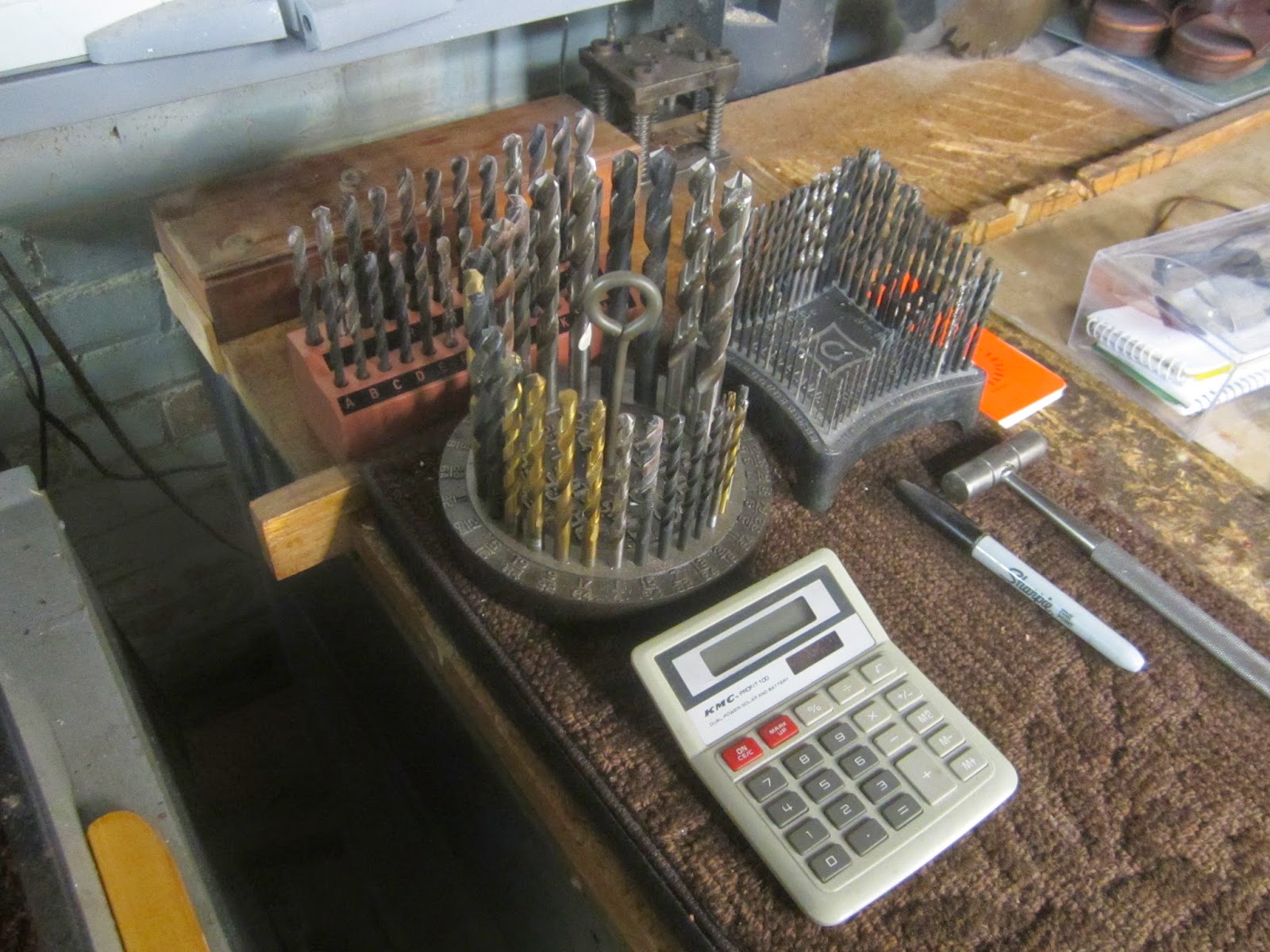
Now this is the BEST; big, heavy, and easy to read the New Process bit holder is beautiful and functional. Plus it's got the pick-up ring in the center for easy moving about.
I refinished it with a paste gun blue after media blasting, then sanded the highlights with 220 on the random orbital and lastly sprayed it with a clear lacquer.
I didn't notice until I went to take the picture that the NP and the Cleavland fit together perfectly about an inch apart!
04.26.14
Well apparently I am the only person that ever wanted a Letter drill holder and since I have never come across one I decided to make my own.
I tried many different designs but had to settle on a very simple shape because I was using my Casio label maker for the letters.
I machined the basic form out of 30 lb. foam. I added a small radius at the top of each opening and machined down into each hole about 0.150" this allowed me to drill each of the holes using the milled guide.
These Cleavland drill bit holders are very cool and when you are in the shop they are always a pleasure to turn to.
As soon as I got the fractional size I realized that there were also numbered drill bit holders out there too.
I will need to do a restoration paint job on the fractional holder in the future.
05.20.13
OK a little Drill bit holder obsession going on here but its fun, they are cool, and I use them.
Next I came across this little gem on EBay and had to have it!
I could see thru the original condition that it was unique and had potential.
Quite a mess so after water blasting I decided to etch the surface so that my paint job would not end up like the original. It seems like a zinc casting so it is nice and heavy but the original surface was so smooth that blue paint had nothing to bite into. I went with a tough gloss black enamel and the next day scraped off each of the fractions, very readable.
I have been designing my own Letter drill set holder but have not settled on a design yet. When I do I will mill it out of heavy tooling foam or aluminum. submit your ideas!
25
07.22.13
I picked up one of these diamond shaped Cleveland Drill holders for another numbered drill set and was so impressed with the usefulness of the design that I quickly went for the fractional size too.
A very nice design; the 64ths run up one side and all the other sizes on the right side, its easy to read and heavy enough to stay on the table. The numbered set goes from 1 to 60 with the odd numbers on the left and even numbers on the right.
Next came this totally unique folding case, normally I dislike folding cases because they are hard to use, hard to read, and hard to keep open. Now this General case solves all of the above issues and does it with beautiful design.
Although not small it is for good reason, it is wide and thin compared to the standard three row case.
When open we have only two rows with this clever folding size plate that has both the fractions and the decimals listed together, big enough and contrasting enough to read easily. In addition it has a Tap drill size chart on the inside of the cover.
It stays open via this cool little red kickstand on the right. All in all a great little design albeit big and heavy its a nice example of let's do it right!
09.21.13
Now this is the BEST; big, heavy, and easy to read the New Process bit holder is beautiful and functional. Plus it's got the pick-up ring in the center for easy moving about.
I refinished it with a paste gun blue after media blasting, then sanded the highlights with 220 on the random orbital and lastly sprayed it with a clear lacquer.
I didn't notice until I went to take the picture that the NP and the Cleavland fit together perfectly about an inch apart!
04.26.14
Well apparently I am the only person that ever wanted a Letter drill holder and since I have never come across one I decided to make my own.
I tried many different designs but had to settle on a very simple shape because I was using my Casio label maker for the letters.
I machined the basic form out of 30 lb. foam. I added a small radius at the top of each opening and machined down into each hole about 0.150" this allowed me to drill each of the holes using the milled guide.
Sunday, March 17, 2013
Vacuum Press EVS - JoeWoodworker
A couple of years ago I wanted to add a vacuum press to my arsenal and after much research I settled on the EVS design by Joe Woodworker.
The difference in part thickness between vacuum press and ambient air F/G layup is about 50%; the 1st pair I made with three layers of glass were only .025" thick. Making parts with the press (when I can) is very rewarding; you know you have got a clean & even part.
I spent a great deal of time designing and reconfiguring the components based on an old 7 gallon air tank I had. I am really happy with this system.
You plug this contraption into the wall and the vacuum pump into it. The hose on the left goes to the bag, the hose on the right goes to the pump. I have the pressure switch set to turn on around 23inches and off around 25inches.
This is my latest project I used it on; a pair of fiberglass insole parts for a set of platform heels I am making from scratch.
The difference in part thickness between vacuum press and ambient air F/G layup is about 50%; the 1st pair I made with three layers of glass were only .025" thick. Making parts with the press (when I can) is very rewarding; you know you have got a clean & even part.
Monday, March 4, 2013
Vise Soft Jaw Liners
I finally made some nice aluminum vise jaw liners that I can use until I go to a better place!
I took a piece of 1 x 1 x 1/8th aluminum extrusion cut to length with a 1/4 in hole on center.
To make them stay in place I drilled two 3/16ths holes deep enough to hold a couple of dowel pins.
And keep the dowel pins on a magnet at the back of the vise.
I took a piece of 1 x 1 x 1/8th aluminum extrusion cut to length with a 1/4 in hole on center.
To make them stay in place I drilled two 3/16ths holes deep enough to hold a couple of dowel pins.
And keep the dowel pins on a magnet at the back of the vise.
Sunday, March 3, 2013
Drill Press Bed Extension
It seemed like every other time I used the drill I either had to move the vice off of the surface or onto the surface.
So I took a piece of scrap aluminum and using the an existing hole in the upright tube clamp I bolted on the custom fit piece to extend the table as far back as possible. The scrap piece had the hole pattern in it which is pretty cool looking.
So now the vice slides far enough back so I should not have to remove it very often.
So I took a piece of scrap aluminum and using the an existing hole in the upright tube clamp I bolted on the custom fit piece to extend the table as far back as possible. The scrap piece had the hole pattern in it which is pretty cool looking.
So now the vice slides far enough back so I should not have to remove it very often.
Subscribe to:
Posts (Atom)
.jpg)
.jpg)
.jpg)
.jpg)


.jpg)
.jpg)

.jpg)
.jpg)
.jpg)

.jpg)
.jpg)

.jpg)
.jpg)

.jpg)